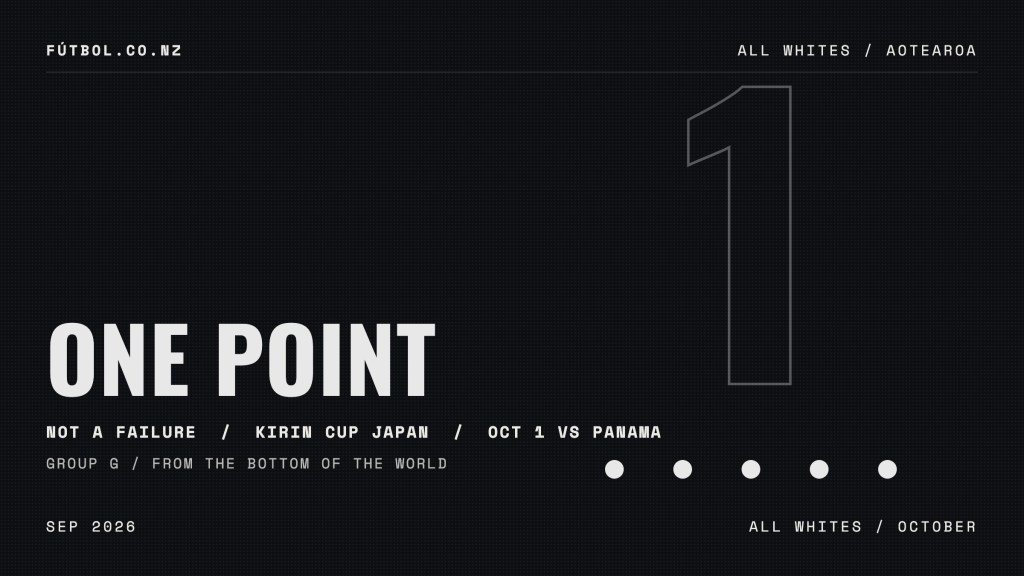
So that is that. The All Whites went to a World Cup, played three games, and came home with one point and a minus-eight goal difference: a 2-2 draw with Iran, a 3-1 loss to Egypt after leading at the break, and a 5-1 hiding from Belgium to sign off. Bottom of Group G, no argument. And I have spent the weeks since watching Kiwi football Twitter tear itself in half over whether that was a heroic effort or a national embarrassment. From the bottom of the world, I am going to plant my flag somewhere most people do not want to stand: it was neither, and I refuse to call it a failure.
One point looks worse than it felt
Let me be honest about the football, because a hincha who only ever defends his team is just a fan with earplugs in. The Iran game was the one that got away. Two points dropped, not one gained, and if you want to know where a World Cup campaign lives or dies, it is in the group opener against the team closest to your level. We were 2-2 and we should have closed it out. That is the result that still keeps me up.
Egypt hurt in a different way. Finn Surman put us in front, we walked off at half time leading a World Cup match, and for forty five minutes an entire country let itself dream. Then the second half arrived and the difference in tempo, in decision making, in that horrible last-thirty-minutes fitness that separates tournament sides from the rest, it swallowed us whole. Three unanswered. And Belgium? Belgium was Belgium. You do not learn much from a 5-1 except how far the summit still is, and there is no shame in being reminded.
Why I will not join the pile-on
Here is the thing the doom merchants keep skating past. This is a country of five million people, a winter code fighting rugby for every kid and every column inch, sending a team to the biggest tournament on earth and taking a point off it. I grew up on Chilean football, where qualifying is a national obsession and missing three World Cups in a row (which is exactly what my Roja has now done) is treated as a house on fire. So believe me when I say I know what actual failure tastes like, and one point at a World Cup is not it.
Failure would have been going there frozen, sitting ten men behind the ball for 270 minutes, and losing three-nil three times while calling it realism. We did not do that. We led against Egypt. We traded blows with Iran. Darren Bazeley took a squad most of the planet could not name and made them competitive for stretches against sides ranked forty and fifty places above us. The scoreline says bottom. The performance said we belong in the room, even if we are still standing near the door.
The real test is in October, not in the post-mortem
This is where I lose patience with the whole failure debate, because it is arguing about a photograph while the film is still rolling. The World Cup was not the destination for this group, it was the education. What matters now is whether any of it stuck, and we find out fast. In October the All Whites head to Japan for the Kirin Cup, an invitational where all four teams (hosts Japan, Ecuador, Panama and us) played at this very World Cup. Bazeley called it a chance to keep testing ourselves against strong, highly ranked sides, and for once the coach-speak is exactly right.
New Zealand open against Panama, with the first game landing Thursday 1 October (NZT), and then it is Japan or Ecuador depending on that result, across Yokohama and Tokyo. Then in November two home games against India, at Auckland’s Go Media Stadium and Christchurch’s One New Zealand Stadium, a rare chance to actually watch this side in the flesh instead of squinting at a stream at some ungodly hour. If the World Cup taught these players anything about closing out games and surviving the last half hour, the Kirin Cup is where I want to see it. Beat Panama, push Japan or Ecuador, and suddenly one point at a World Cup looks like a floor, not a ceiling.
What I actually want
I do not want the All Whites to spend the next year being congratulated for turning up. I want them annoyed. I want that Iran draw to sit in the squad like a splinter, because a team that learns to hate a point it should have turned into three is a team that grows. Chile’s problem for a decade has been the opposite: too much nostalgia, too many pats on the back for a golden generation that is long gone. Do not let that happen here.
So no, I will not call it a failure. I will call it a beginning that has to be paid off, and the first instalment is due in Japan in October. Set an alarm, put the jug on, and let us see what they actually learned. Kia kaha, All Whites. The door is open. Now walk through it.


Leave a comment