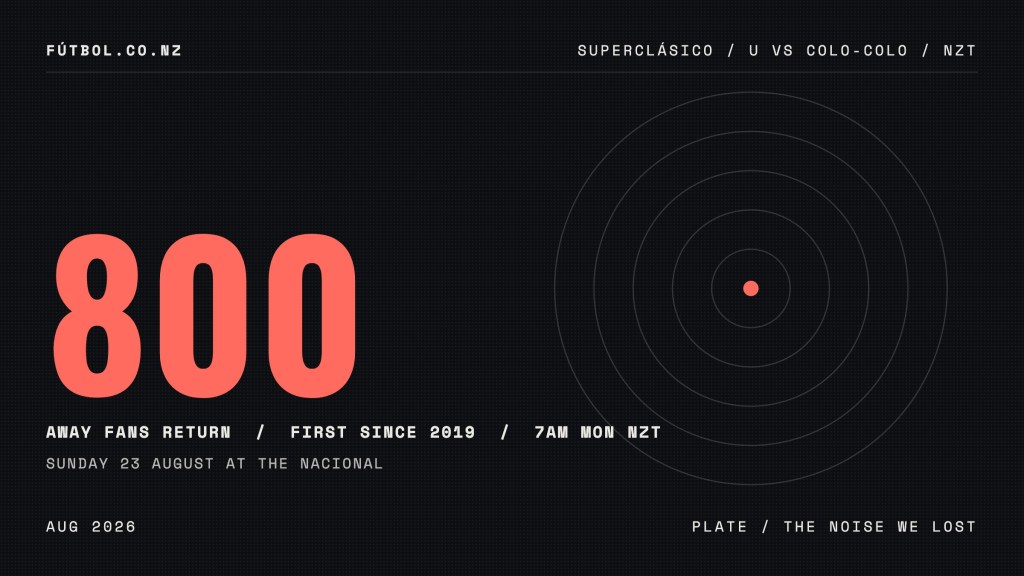
There is a fixture on the Chilean calendar that I organise my whole month around, even from 11,000 kilometres away with the kettle on at an hour no sane person should be awake. On Sunday 23 August, Universidad de Chile host my Colo-Colo at the Estadio Nacional in Santiago, kick-off at 3pm Chilean time, which for those of us at the bottom of the world means 7am on Monday morning here in New Zealand. Set the alarm now.
But the score, this time, is not the story that has me pacing the kitchen. The story is that after seven long years, the Superclásico is getting its away end back.
Eight hundred tickets, and why the number matters
Here are the cold facts. The Estadio Nacional will open to a capacity of around 45,000, and inside that number there will be a small pocket, roughly 800 Colo-Colo supporters, tucked into the Tribuna Pacífico Norte. Eight hundred. In a rivalry this size that is barely a rounding error, a single travelling coach’s worth of people in a stadium built for tens of thousands. And yet I read the news and felt something I had not felt about the Superclásico in years: hope, mixed with a lump in the throat.
Because visiting fans have not been allowed at Chilean classics since 2019. Seven years of derbies played to one colour, one half of the story, the away end sealed shut like a wound nobody wanted to look at. If you did not live through South American football before that, it is hard to explain what was taken away. The away support is not decoration. It is the argument made flesh, the reason a Superclásico sounds different from a friendly, the low rolling threat from the corner that tells the home crowd they do not own the night after all.
What we lost when the away ends went dark
I grew up on stories, and later on grainy streams, of stadiums where both hinchadas were in the building at once. The banners the size of apartment blocks, the drums answering each other across the pitch, the sense that you were walking into someone else’s cathedral and daring to sing in it. That is the culture I carry around in New Zealand like a stone in my pocket. It is the thing I miss most watching football here, where the atmosphere is warm and friendly and, if I am honest, a little polite.
When Chile locked the away fans out, the official reason was safety, and I will not pretend the violence that triggered it was imaginary. It was real and it was ugly. But something quieter died alongside it. A whole generation of kids has now grown up going to the Superclásico without ever standing near an opposing fan, without learning that you can hate a colour for ninety minutes and still share a pavement afterwards. You cannot teach that from behind a screen. You learn it in the stands or you do not learn it at all.
The part that makes me uneasy
So why am I not simply celebrating? Because of how they are doing it. Those 800 Colo-Colo fans will not so much be welcomed as contained, sealed into an encapsulated sector with a heavy security ring around them to keep the two sides apart. And this match will also be the debut of a new facial-recognition system, bought from a Brazilian company, aimed at killing off ticket resale and keeping banned troublemakers out.
Part of me understands it. If a caged corner and a camera scanning my face are the price of hearing an away drum in a Superclásico again, I will pay it, and I suspect most of you would too. But part of me bristles. This is not the reintegration I dreamed about. It is a tightly policed experiment, 800 people held up as proof of concept, and if a single flare gets thrown the whole thing can be shut down again for another seven years. That is a lot of weight to put on a handful of supporters. I want it to work so badly that I am scared of how easily it could be used to justify going backwards.
Watching from the edge of the world
On the football itself I stay stubbornly nervous, the way any Colo-Colo fan is contractually obliged to be walking into the Estadio Nacional. La U at home, in front of their own crowd, with our away corner finally singing back, is exactly the kind of night that does not care what the league table says. I would take a draw and run. I always say that and I never mean it.
If you are here in New Zealand and want to feel a little of what I am talking about, find a stream, make the coffee strong, and be sitting down by 7am on Monday. Listen for the corner. Eight hundred voices is not many, but after seven years of silence it might just be the sweetest sound in Chilean football. Vamos el Cacique.



Leave a comment