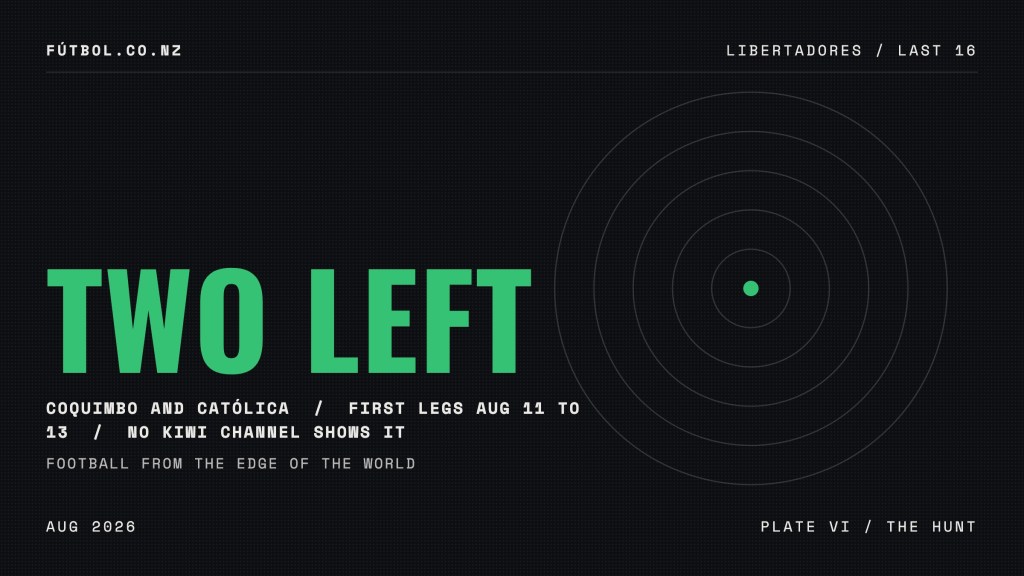
The World Cup is over, Spain are champions, and every football page in New Zealand has already turned the calendar to 21 August and the Premier League. Fair enough. But while you lot count down to Sky and the same twenty clubs, something far more dangerous is warming up in the south. The Copa Libertadores, South America’s Champions League, is about to reopen its doors for the last 16, and Chile still has two teams inside the building.
Not my Colo-Colo, I will get that heartbreak out of the way now. El Cacique is running away with the Chilean league, thirteen points clear, the best domestic season in a generation, and yet we are not in this. The continent chewed us up earlier in the year and spat us out. So the two flags I am carrying into August belong to a small port club and, God help me, to a rival I have spent my whole life booing.
What the Libertadores actually is, for the Kiwi reading this
Imagine the Champions League, then take away the polish. The Copa Libertadores is South America’s biggest club competition, and it is not a glossy corporate product. It is played at altitude that leaves you gasping, in stadiums where the away team gets pelted with flour and abuse before kickoff, on pitches that range from immaculate to farmyard. Referees get surrounded. Ties get decided on penalties in front of eighty thousand people who genuinely believe their life depends on it. The final this year is a single match at the Estadio Centenario in Montevideo on 28 November, the ground where the very first World Cup was won in 1930. That is the stage these two Chilean sides are three rounds away from.
You will not have heard of most of the clubs. That is the point. This is the tournament that made Boca, River, Flamengo and Peñarol into myths, and it eats giants for breakfast.
Coquimbo Unido, the story I did not see coming
Coquimbo Unido are from a port city on the north coast of Chile, a club whose supporters call themselves the pirates, aurinegro, black and gold, salt in the air. For most of my life they were a yo-yo team, up one season and down the next. Now look at them: they topped their Libertadores group, ahead of clubs with ten times their budget, and they are into the last 16 of the biggest tournament on the continent. If you had told me that two years ago I would have laughed in your face.
They draw Platense, an Argentine side from the outskirts of Buenos Aires, over two legs. First leg is away in Argentina on Wednesday 12 August in the evening, which lands here around 10am on Thursday 13 August NZT. The return is at home in Coquimbo the following week. A small club, a hostile away trip, a two-legged knockout: this is exactly the kind of night the Libertadores was invented for, and I will be watching it before work with my heart in my mouth.
And then there is Católica, the one I have to cheer for
Universidad Católica are the club I am supposed to hate. They are one of Colo-Colo’s great rivals, they sit well behind us in the league table this year, and every instinct in my body says root against them. But here is the thing about continental football: when a Chilean side crosses the border, the shirt stops mattering and the flag takes over. In the Libertadores I am not a Colo-Colo hincha, I am a Chilean, and Católica are ours.
They have drawn Estudiantes de La Plata, one of the most storied and streetwise clubs in Argentina, four times champions of this competition and never, ever an easy out. First leg is away in La Plata on the night of Tuesday 11 August, which is roughly 12:30pm here on Wednesday 12 August NZT. If Católica can come out of Argentina still alive, the second leg in Santiago on 18 August becomes one of those Chilean nights that make the whole country stop. I will grit my teeth, I will swallow the rivalry, and I will want them through.
Why this matters at the bottom of the world
Here is the frustrating part. The World Cup was free, in your lounge, on TVNZ, and half of New Zealand had an opinion on Belgium by the end of it. This will be nothing like that. No Kiwi channel is going to hand you the Libertadores on a plate, so following it from here means hunting down a stream, setting a stupid alarm, and explaining to your workmates why you look like you have not slept. Welcome to my life for the next three months.
But it is worth it, and I would argue it is worth more than the polished stuff precisely because it is harder to reach. This is football with its collar up and its knuckles bruised, the competition that shaped the way an entire continent feels about the game. Two Chilean clubs are still standing in it, one of them a little port team living a fairy tale, and from ten thousand kilometres away I am not going to miss a minute. If you want to understand why South Americans are the way we are about this sport, do not watch the highlights. Find the stream, sit through the flour and the fireworks and the penalties, and you will get it.
Coquimbo and Católica, two flags, one hincha at the bottom of the world. Vamos.


Leave a comment